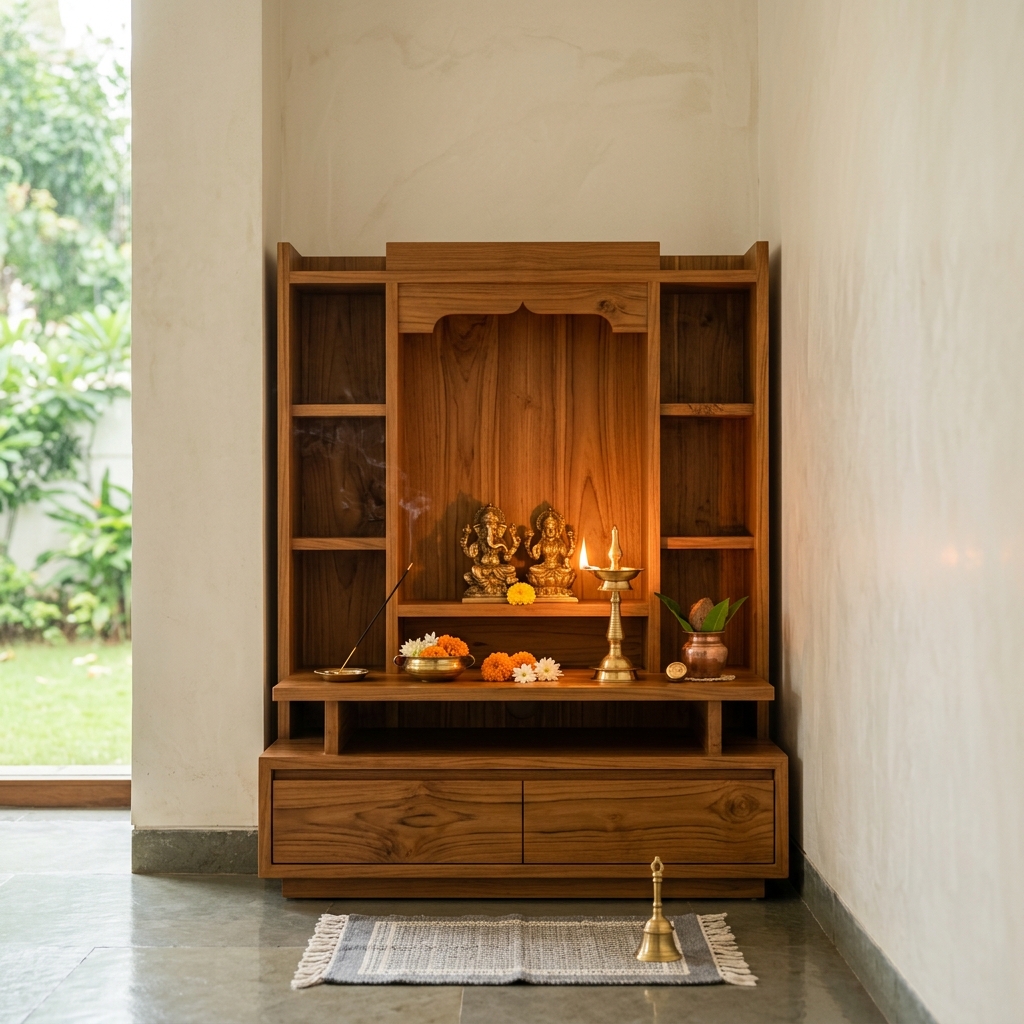

In every home that follows Sanatana Dharma, the deity room — or Garbhagriha (literally "womb chamber") — is the most sacred space. It is not merely a room with idols; it is a spiritual generator that, when designed correctly, amplifies the energy of devotion manifold.
The Garbhagriha is not a new concept. In ancient Indian temple architecture (the Nagara, Dravida, and Vesara styles), the Garbhagriha was always the smallest, darkest, and most concentrated space in the temple. It was designed to be womb-like — dark, warm, and insulated from external noise — so that the devotee's consciousness could turn inward without distraction.
In a modern home, the deity room serves the same purpose. It is a spiritual battery that charges the entire household's energy. When designed correctly, the effects are tangible: family members report feeling calmer, arguments decrease, and a sense of protection pervades the home.
Over the past 18+ years of ISKCON practice and architectural work, we have designed deity rooms for families, temple communities, and ashrams across Maharashtra. In this article, we share the essential principles of Garbhagriha design according to Vastu Shastra.
1. Location: Where Should the Deity Room Be?

The ideal location for the deity room is the Northeast (Ishan) corner of the home or temple. The Northeast is ruled by Ishana (Shiva) — the lord of all directions. It is the zone of water, purity, and spiritual energy.
Hierarchy of acceptable locations:
- Northeast (Ishan) — Best. The altar should face East or West.
- East (Indra) — Acceptable. The devotee faces West while worshipping.
- North (Kubera) — Acceptable. Associated with prosperity and abundance.
- Central hall (Brahmastan) — Acceptable only if the room is open, elevated, and free of obstructions.
Locations to avoid: South (Yama — lord of death), Southwest (demonic energies), and Southeast (Agni — fire zone, too hot for deities). Never place a deity room next to a toilet or kitchen.
2. Orientation: Which Direction Should the Altar Face?
The devotee should face East or North while worshipping. This means the deities should be placed on the West or South wall, facing East or North respectively.
- Facing East: The most preferred direction. The devotee faces the rising sun, which represents knowledge and awakening. The altar is on the West wall.
- Facing North: The second-best option. The devotee faces Kubera's direction (wealth and abundance). The altar is on the South wall.
- Facing West: Acceptable only if the main entrance forces this orientation. The altar is on the East wall.
- Facing South: To be strictly avoided. South is Yama's direction — the lord of death. Never place deities facing South.
3. Altar Platform (Aasan): Height and Material
The platform on which the deities rest has specific dimensional guidelines:
- Height: The ideal platform height is 4 to 6 inches (approximately 10-15 cm). It should be elevated but not so high that the deities are above the devotee's eye level when seated.
- Material: Use marble, granite, or stone. Wood is acceptable but less preferred. Avoid metal platforms for the main deities.
- Shape: A rectangular or square platform is best. Circular platforms are used only for specific deities (like Shiva Linga).
- Single vs. Multiple Levels: In ISKCON tradition, the main deities (Radha-Krishna, Gaura-Nitai) are on the highest level. Shiva, Hanuman, and other deities are on lower levels. Never place any deity above Radha-Krishna.
4. Lighting and Ventilation
The Garbhagriha should be bright, airy, and fragrant. Here are specific guidelines:
- Natural light: The room should have at least one window in the East or North wall to allow morning sunlight. Morning sattvic light elevates the spiritual atmosphere.
- Artificial lighting: Use warm LED lights (2700K-3000K) — never cool white or blue light. The glow should mimic ghee lamp light. Install dimmers for flexibility during arati times.
- Ventilation: An exhaust fan in the North or East wall prevents smoke and incense buildup. Avoid fans directly over the altar.
- Skylight: A small skylight directly above the altar is considered highly auspicious — it allows cosmic light (prana) to descend onto the deities.
5. Materials, Colors, and Décor
Flooring: Marble or polished granite. Avoid ceramic tiles with heavy patterns. A single-color floor (white, cream, or light beige) keeps the focus on the deities.
Walls: Paint in soft sattvic colors — off-white, cream, light yellow, or soft pink. Avoid dark colors, busy wallpapers, or mirrors inside the deity room. The wall behind the deities can have a gentle gold or ochre accent.
Décor:
- Fresh flowers daily (avoid artificial flowers on the main altar).
- Oil lamps (ghee or sesame oil) on the right and left of the deities.
- A small bell hanging at the entrance — ring it before entering.
- A chandramouli (peacock fan) and chamara (yak-tail whisk) for deity service.
- No photographs of family members inside the deity room. Keep family photos in the living room.
6. Electrical and Plumbing Considerations
These practical considerations are often overlooked by architects:
- Electrical sockets: Place them discreetly behind the altar or on side walls — never directly in front of the deities.
- No plumbing: The deity room must have no water pipes, drainage, or toilet connections within or adjacent to it. Water sounds disturb the meditative atmosphere.
- Sound system: Pre-wire for a small speaker for bhajan/kirtan. The speaker should be on the East or North wall, not directly above the deities.
- Storage: Include a small cupboard or drawer for deity clothing, garlands, and paraphernalia — preferably built into the West or South wall.
7. The Deity Room in Apartments
If you live in an apartment and cannot choose the room location, here is how to make the best of your space:
- Choose the Northeast room if available. If not, the East-facing or North-facing room is next best.
- Use a wooden cabinet mandir if no separate room is available. Place it against the West or South wall so you face East or North while worshipping.
- Keep the cabinet elevated on a 4-inch wooden platform.
- Never place the mandir in the bedroom unless absolutely unavoidable. If you must, ensure the deities are covered during intimate times.
- No mandir under a staircase, in a kitchen, or in a toilet passage.
Vastu Yantra and Sacred Geometry in the Deity Room
Beyond the physical layout, Vastu Shastra recommends specific yantras (geometric energy diagrams) to amplify the spiritual energy of the Garbhagriha:
- Shri Yantra: The most powerful of all yantras. Place a copper Shri Yantra on the North or East wall of the deity room, at eye level when seated. It is believed to attract prosperity, harmony, and spiritual evolution.
- Vastu Purusha Yantra: A secondary yantra placed near the entrance of the deity room or embedded in the altar platform. It aligns the room's energy with the cosmic Vastu Purusha.
- Om symbol: The sacred sound symbol should be etched or painted on the wall behind the main deities. It acts as a visual mantra — every glance realigns the devotee's consciousness.
- Swastika: Place a Swastika symbol (drawn with kumkum or etched in metal) at the entrance threshold of the deity room. It is a mark of auspiciousness and protection.
Placement note: Yantras should be installed during an auspicious muhurta (astrologically favorable time). We guide our clients on the appropriate timing based on their family's nakshatra (birth star).
For those unfamiliar, a yantra is not an idol to be worshipped. It is a geometric tool — like a lens that focuses spiritual energy. The Shri Yantra, in particular, has been studied by physicists for its precise mathematical ratios and their effect on human brainwave patterns.
Our Deity Room Design Service
At Spazia, we offer a specialized Sacred & Community Architecture service that includes:
- Vastu-compliant deity room layout with proper orientation and dimensions.
- 3D massing model showing the altar, lighting, and furniture placement.
- Working drawings for your carpenter or contractor.
- Vedic consecration (Prana Pratishtha) guidance.
Common Mistakes in Deity Room Design
From our consultations, here are the most frequent errors we see:
- Deities facing South: This is the most common and most severe mistake. Always ensure the deities face East or North.
- Deity room used as a passage: The room must have only one purpose — worship. If people walk through it to reach another room, the energy is disturbed.
- Too much storage: Cupboards, suitcases, and old clothes stored in the deity room clutter the energy. Keep only worship-related items.
- Artificial flowers only: While artificial flowers are acceptable for decoration, the main offering should always include fresh flowers. Dried or wilted flowers must be removed daily.
- Footwear inside: Strictly no footwear inside the deity room. Keep a shoe rack outside the door.
Deity Room Maintenance Rituals
Once the room is built, regular maintenance ensures the energy remains high:
- Daily: Light a ghee lamp at dawn and dusk. Offer fresh flowers and incense.
- Weekly: Deep clean the room. Wipe the altar with a damp cloth. Change the water in the copper vessel.
- Monthly: Rearrange the fresh flowers. Check for cobwebs or dust behind the deities.
- Yearly: Repaint the room if colors have faded. Deep clean or replace the curtain at the entrance.
Whether you are building a home mandir or a 50-foot temple Garbhagriha, we ensure every dimension serves the divine. Our Sacred & Community Architecture service includes complete Garbhagriha design with Vastu validation, working drawings for your contractor, and consecration guidance. Book a consultation and let us help you create a space where the divine feels at home.
Written by Nihar Sail, Principal Vastu Consultant at Spazia. ISKCON practitioner since 2006. COA-Registered Architect.