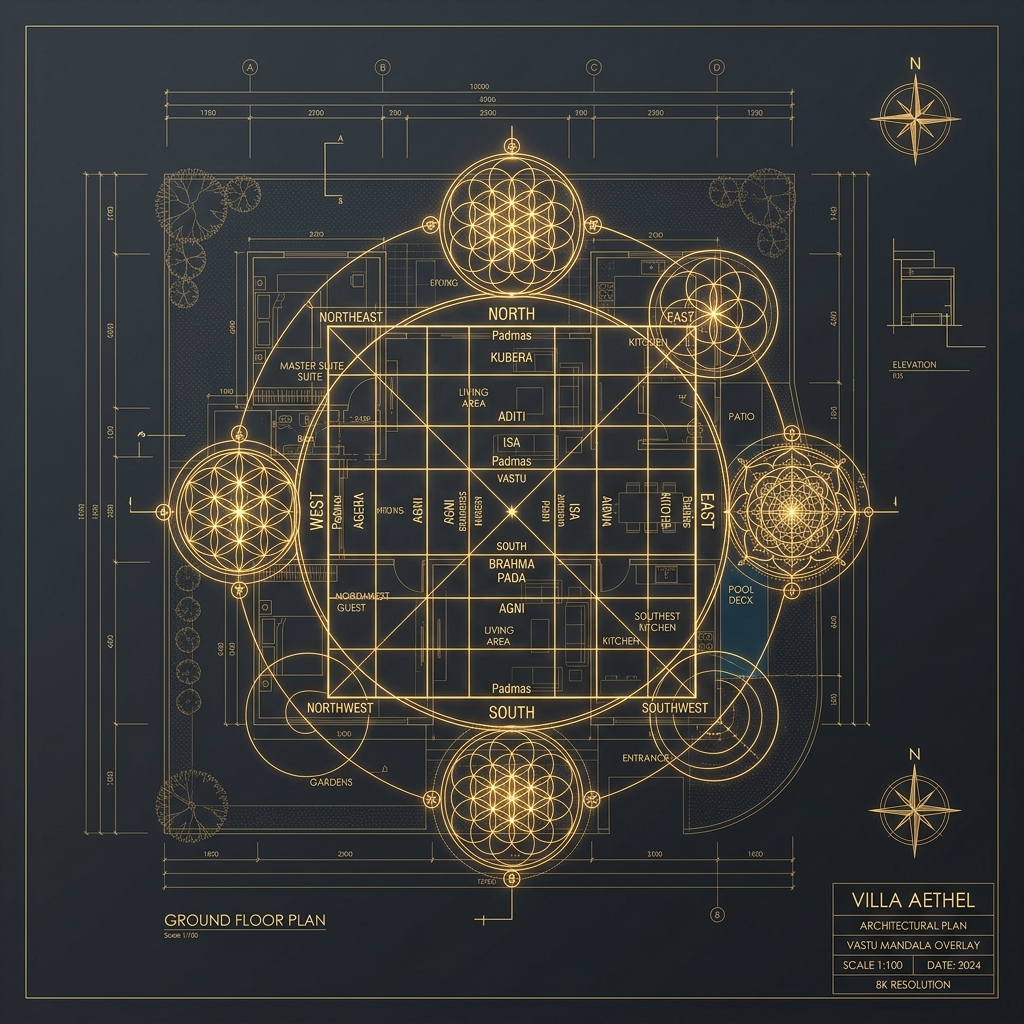
Understanding the Vedic Science of Ayadi Shadvarga
In classical Vastu Shastra, architectural design is not merely an aesthetic or structural practice; it is a spiritual calibration. Sourced directly from authentic texts like the Samarangana Sutradhara and Mayamata, the system of Ayadi Shadvarga (the six formulas of spatial energy) is utilized to ensure that a building resonates in harmony with cosmic wavelengths and its owner's birth star.
Brihat Samhita (53.58):
दक्षिणे पश्चिमे चैव सोपानं कारयेत् (Dakṣiṇe paścime caiva sopānaṁ kārayet)
"Heavy structures, stairs, and structural pillars must sit in the South or West (Yama/Varuna) zones to serve as stabilizing weights."
The Six Pillars of Ayadi
Each parameter is calculated using the external perimeter of the building foundation (bhitti-bahya-sutra) in classical whole Hasta units:
- Aya (Income/Gain): Represents incoming positive energetic and financial flow. Calculated as
(Perimeter × 8) &bmod; 12. Remainder 1 (Dhwaja) or 7 (Gaja) are highly auspicious. - Vyaya (Expenditure/Loss): Measures energy drainage. Aligned via
(Perimeter × 9) &bmod; 10. To ensure wealth retention, Aya must always exceed Vyaya. - Yoni (Directional Energy): Determines the building's orientation resonance. For an East-facing entry, a remainder of 1 (Dhwaja Yoni) is optimal.
- Nakshatra (Astrological Star): Matches the structure's energy to the janma nakshatra (birth star) of the owner.
- Ayu (Lifespan): Calibrates the durability of the building, aiming for a lifespan exceeding 60 years.
- Amsa (Quality Factor): Indicates the spiritual quality of the house. Remainders pointing to Deva (Divine) or Gaja (Prosperity) are preferred.
By using parametric calculators like Spazia's 3D Studio, modern architects can align these ancient parameters automatically, achieving flawless shastric compatibility.